

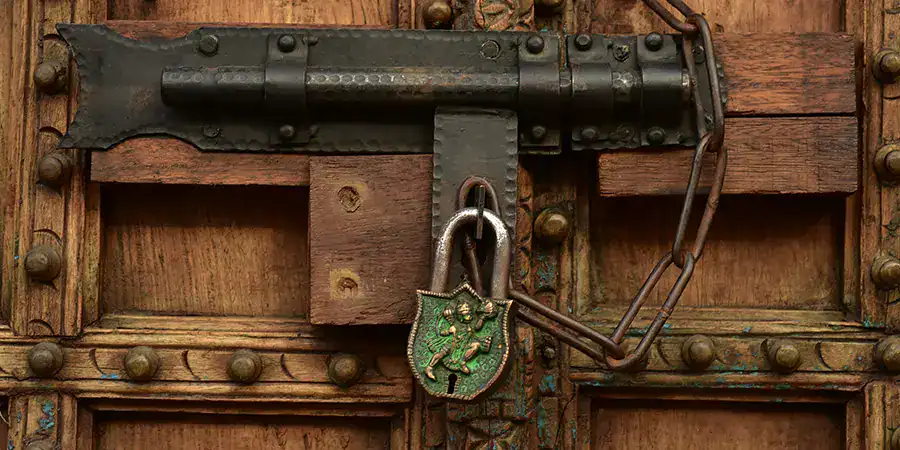
Locks have protected property and valuables for over 4,000 years. What began as simple wooden mechanisms in ancient Mesopotamia and Egypt evolved into metal locks in the Roman era and precision-engineered systems during the Industrial Revolution.
Today, security has gone digital with smart locks, biometrics, and mobile integration redefining how we protect our homes.
The First Line of Defense for Your Home
Protecting your property is a core part of homeownership, and home security starts at your front door. We use locks every day without thinking twice, but behind that simple turn of a key are thousands of years of innovation.
Understanding how locks evolved helps you:
- Appreciate the technology protecting your home
- Make smarter upgrade decisions
- Choose the right solution for your lifestyle
Whether you’re tackling a DIY upgrade or hiring a professional, knowing your options is key.
The Earliest Security: Wooden Pin Tumblers
The first locks date back thousands of years, when early civilizations needed to protect their property and goods.
- The oldest known lock (around 4,000 BC) was found in ancient Assyria.
- Made of wood, it used a basic pin tumbler system.
- This was later refined by the ancient Egyptians.
These early wooden locks were massive—sometimes up to two feet long—but effective for their time. They worked by:
- Using a heavy wooden crossbar to secure the door.
- Inserting a wooden key with pegs.
- Lifting internal pins to release the lock.
The Roman Era: Metal Locks and Ward Keys
The Romans transformed lock design through advances in metalworking.
Key innovations included:
- Stronger materials like iron and bronze.
- Smaller, more durable lock designs.
- The introduction of warded locks.
A warded lock uses a series of concentric metal plates or obstructions (called wards) inside the keyhole. A standard key for that lock has specific notches cut into its blade that match the shape of those wards.
Most of us are familiar with old-fashioned “skeleton” keys, which are actually a bit of a “hack.” Instead of having complex notches to match every single ward, the key is filed down—or “stripped to its skeleton”—so that only the very tip (the bit) remains. It can bypass the wards, reach the mechanism’s back, and open the lock.
The Industrial Revolution: A Leap in Locksmithing
For centuries, lock design changed very little until the Industrial Revolution.
Precision engineering brought major breakthroughs:
Robert Barron (1778)
- Invented the double-acting tumbler lock
- Required exact alignment for added security
Joseph Bramah (1784)
- Created a highly secure cylindrical lock
- Offered a reward to anyone who could pick it (it stood for decades)
Linus Yale Sr. & Jr. (1800s)
- Developed the modern pin tumbler lock
- Introduced the flat, serrated key still used today
- The Yale design remains the standard for residential locks; it’s affordable, reliable, and easy to rekey.
The Digital Age: Electronic and Smart Security
Modern security has gone beyond physical keys.
Today’s smart locks offer:
- Smartphone control for locking/unlocking
- Biometric access (fingerprint or facial recognition)
- Temporary digital keys for guests or contractors
- Real-time access monitoring
- Integration with smart home systems
For homeowners, this means greater convenience and enhanced security. Many smart locks are DIY-friendly and can be installed in under an hour.
Protecting Your Home with Local Experts
If your locks are outdated or worn, upgrading is one of the most cost-effective ways to improve security.
A full-service locksmith can help with:
- Rekeying – Change keys without replacing the lock
- High-security locks – Protection against picking and bumping
- Decorative hardware – Combine style with durability
- Safes & vaults – Protect valuables and documents
- 24/7 emergency service – Fast help when you’re locked out
Working with local experts ensures faster service, better products, and advice tailored to your neighborhood. DIY is great, but some upgrades are best left to professionals.
Upgrade Your Southern California Home Security
Your home is one of your most valuable assets; don’t rely on outdated locks to protect it!
Do a quick check:
- Are your locks sticking?
- Rusting?
- Hard to turn?
If yes, it’s time to upgrade.
Simple improvements like rekeying existing locks, installing a smart lock, and upgrading to a modern deadbolt can dramatically improve your home’s security.
From ancient wooden mechanisms to today’s smart technology, locks have always evolved to meet the need for better security. Upgrading your home’s locks is a simple step that delivers lasting protection, convenience, and peace of mind.
FAQs: The History of Locks
Q: What is the oldest type of lock?
The oldest known lock is the wooden pin tumbler lock from ancient Assyria (around 4,000 BC), later adopted by the Egyptians.
Q: How does a pin tumbler lock work?
It uses spring-loaded pins of different lengths. The correct key aligns the pins at the shear line, allowing the lock to turn.
Q: What is rekeying?
Rekeying changes the internal pins so old keys no longer work. It’s a cost-effective alternative to replacing the entire lock.
Q: Can I install a smart lock myself?
Yes. Most are designed for DIY installation and require only basic tools and about 30 minutes.
Q: Is there any advantage to using a local locksmith rather than a big box store?
Local locksmiths offer faster service, tailored advice, and support your community. They also carry hardware that big box stores don’t offer.
Q: Do smart locks improve energy efficiency?
Yes, they can. Many integrate with smart home systems to adjust HVAC settings when you leave.
Q: What should I do if I am locked out?
Avoid forcing entry. Call a 24/7 locksmith who can safely open your door and create new keys if needed.
Q: How often should I replace my locks?
Replace or rekey when moving into a new place, after losing keys, after a break-in, or when locks show wear.