

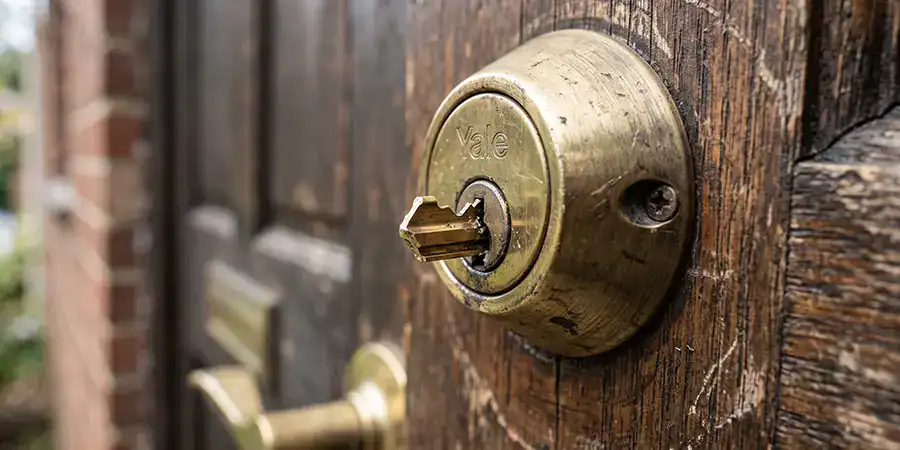
Hearing your house key snap off inside a high-security lock is the bummer of all bummers.
But pause for a moment before you force it or jam the wrong tools into the cylinder. High-security locks need a gentler touch. From quick DIY extractions to pro locksmith tricks, here’s how to get your key back without ruining your deadbolt.
1. Stay Calm & Assess the Situation
Rushing leads to mistakes — and mistakes can push a broken key fragment deeper into the cylinder, making extraction significantly harder.
Look closely at the lock. Ask yourself:
- Is any part of the key still visible or protruding from the keyway?
- Is the key flush with the lock face, or recessed inside the cylinder?
- Is the lock in the open or closed position?
These details determine which extraction method is your best bet. A key that’s partially visible is far easier to remove than one that has snapped off deep inside.
2. Gather the Right Tools Before You Start
Attempting to extract a broken key with the wrong tools — or improvised ones — can damage the lock cylinder. High-security deadbolts are precision-engineered, and their internal components are more tightly toleranced than standard locks.
Recommended extraction tools include:
- Key extractor kit: Available at most hardware stores for 15–30. These thin, hooked metal tools are designed to grip and pull key fragments.
- Needle-nose pliers: Useful if a portion of the key is still protruding.
- Tweezers: For very small protruding fragments.
- Lubricant: A graphite-based lubricant (not WD-40, which can gum up pin tumblers over time) reduces friction during extraction.
Avoid using glue, tape, or superglue inside the lock. Adhesive-based methods almost always make things worse.
3. Lubricate the Lock Cylinder
Before attempting any extraction, apply a small amount of graphite lubricant or dry Teflon spray into the keyway. This reduces friction between the broken key fragment and the cylinder walls, making it easier to maneuver and remove the piece.
Give the lubricant about 30–60 seconds to work into the cylinder before proceeding. Don’t over-apply — a little goes a long way in a precision mechanism.
4. Try Needle-Nose Pliers If the Key Is Protruding
If even a small portion of the key is sticking out from the keyway, needle-nose pliers are your first line of attack. Grip the exposed metal as close to the lock face as possible and apply slow, steady outward pressure. Avoid twisting or wiggling aggressively — this can snap the fragment further or damage the keyway.
If the pliers can’t get a firm grip, tweezers with a fine tip may work better for smaller protrusions.
5. Use a Key Extractor Tool for Flush or Recessed Breaks
When the key has snapped off flush with the lock face — or just inside it — a key extractor is your best DIY option.
Here’s how to use one:
- Insert the hooked end of the extractor into the keyway alongside the broken fragment.
- Hook the extractor’s tip into the key’s serrations (the jagged cuts along the edge).
- Apply gentle outward pressure while slightly rotating the extractor.
- Work slowly — patience here prevents the fragment from shifting position.
Key extractor kits typically include several tool profiles. If one doesn’t catch, try another. High-security cylinders with tighter tolerances may require a thinner extractor profile.
6. Try the Tap & Shake Method as a Last Resort
If you don’t have extraction tools on hand, try this: hold the lock in a position where gravity works in your favor (the keyway facing downward), then tap the lock body firmly but carefully with the palm of your hand or a rubber mallet. The vibration — combined with the lubricant — can sometimes shift a fragment enough for it to fall free.
This method works best when the key broke off near the front of the cylinder. It’s far less effective for deeper breaks.
7. Know When to Stop & Call a Locksmith
There’s a point at which continued DIY attempts do more harm than good. Call a professional locksmith if:
- Multiple extraction attempts have pushed the fragment deeper.
- You can feel the key fragment rotating the cylinder (you may inadvertently be picking your own lock).
- The lock cylinder itself feels damaged or jammed.
- You can’t afford to risk damaging a high-security deadbolt that cost several hundred dollars.
A licensed locksmith has specialized tools — including plug followers, pick guns, and professional extractor sets — that can handle even the most stubborn fragment without having to replace the entire lock.
8. Prevent It from Happening Again
Once the immediate problem is resolved, take steps to prevent a repeat situation.
- Replace worn keys immediately. Keys develop stress fractures over time, especially at the bow (the part you grip). If your key is visibly worn, bent, or difficult to turn, replace it before it breaks.
- Don’t force a stiff lock. A lock that requires extra force to turn is a warning sign. Lubricate the cylinder and address the root cause rather than applying more pressure.
- Get a duplicate made professionally. Poor-quality key duplicates are more prone to breaking. Have copies cut at a reputable hardware store or locksmith, not a self-service kiosk.
- Service your deadbolt annually. High-security deadbolts last longer with regular lubrication and inspection.
FAQs: Recovering a Broken Key from a Deadbolt Lock
Q: Can I use super glue to extract a broken key from a lock?
No. Applying adhesive inside a lock cylinder almost always makes things worse. Super glue can bond the key fragment to the cylinder pins, transforming a manageable extraction job into a full cylinder replacement. Stick to mechanical extraction methods and lubricants.
Q: What if the key broke off while the deadbolt was in the locked position?
This is the trickier scenario. If the lock is locked, you’ll need to extract the key before the deadbolt can be operated. In some cases, a locksmith may use a plug follower to manipulate the cylinder while the fragment is still inside — but this is not a DIY technique.
Q: Will my homeowners’ insurance cover a broken-key lockout?
Some homeowners’ insurance policies include locksmith coverage under their “home assistance” or “emergency services” rider. Check your policy details. Many insurance providers in California offer optional coverage for lockouts that includes partial reimbursement for locksmith fees.
Q: Can I replace just the cylinder, or do I need a whole new deadbolt?
In most cases, a locksmith can rekey or replace the cylinder without replacing the entire deadbolt. This is the more affordable option and is typically recommended unless the lock body itself is damaged.
Q: How do I know if my high-security deadbolt cylinder is damaged after a broken key incident?
- Signs of cylinder damage include:
- Difficulty inserting a new key
- Visible scoring or scratching inside the keyway
- A cylinder that turns stiffly or unevenly
- A lock that no longer latches properly.
If you notice any of these, have a locksmith inspect the cylinder before relying on it for security.
Q: What types of keys are most prone to breaking inside a lock?
Thin, heavily worn keys — and poorly made duplicates — are the most common culprits. Keys made from softer metals (like those cut at low-cost kiosks) are more susceptible to metal fatigue and bending. High-security locks that are stiff or misaligned put additional stress on the key, accelerating wear.
Q: Is it possible to extract a broken key without any tools?
Occasionally, if the fragment is protruding enough, you can use your fingernail or a credit card edge to wiggle it free. But in most cases, attempting tool-free extraction isn’t effective and risks pushing the fragment deeper. A basic key extractor kit is a worthwhile addition to any DIY toolbox.
Q: How long does professional key extraction typically take?
An experienced locksmith can typically extract a broken key from a standard deadbolt in 15–30 minutes. High-security deadbolts with tighter tolerances may take longer. If the cylinder needs to be rekeyed or replaced after extraction, add another 15–30 minutes to the estimate.