
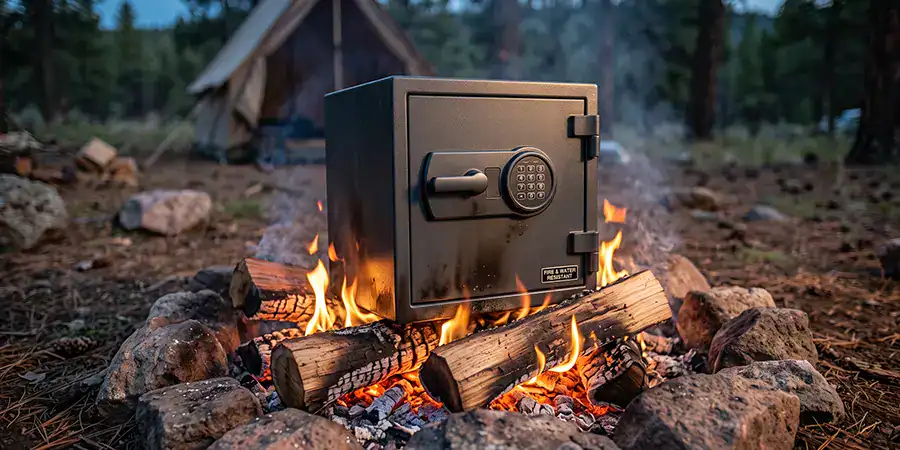
Imagine surviving a house fire, opening your “fireproof” safe, and finding your birth certificate perfectly intact, while your grandmother’s heirloom pearls have been ruined.
It happens more often than you think. Most people assume a fire rating is a blanket promise of protection, but storing paper and jewelry in the same safe is a gamble. The wrong safe won’t just fail to protect your treasures — it can actively destroy them.
Here’s why one fire rating doesn’t fit all, and what you need to know before buying.
What Are Document Safes?
Document safes are designed to safeguard paper, photos, and digital media from fire damage.
- Primary purpose: Protect combustible materials like paper, passports, birth certificates, and USB drives
- Key feature: Insulated walls that keep the internal temperature below the point at which paper burns (approximately 451°F / 233°C)
- UL fire rating: Most are rated UL Class 350, meaning the interior stays at or below 350°F during a fire
- Common formats: Freestanding floor safes, wall safes, and fireproof filing cabinets
Document safes work by releasing moisture stored in their walls during a fire. This keeps the interior cool and humid — ideal for paper, but not for everything else.
What Are Jewel Safes?
Jewel safes (also called jewelry safes or high-security safes) are built around two priorities: theft prevention and heat resistance at higher temperatures.
- Primary purpose: Protect metal, gemstones, coins, and other valuables
- Key feature: Higher internal temperature tolerance, since metals and stones don’t burn but can warp, melt, or discolor at extreme heat
- UL fire rating: Typically rated UL Class 125 or UL Class 150, keeping interiors below 125°F or 150°F
- Common features: Heavier steel construction, pry-resistant doors, and advanced locking mechanisms
The lower internal temperature limit isn’t a flaw — it’s intentional. Jewelry requires cooler conditions to endure.
Understanding Fire Ratings
Fire ratings tell you how long a safe can maintain a specific internal temperature during a standardized fire test. Here’s a quick breakdown:
UL Class 350
- Max Internal Temp: 350°F (177°C)
- Protects: Paper, documents
UL Class 150
- Max Internal Temp: 150°F (66°C)
- Protects: Digital media, magnetic tape
UL Class 125
- Max Internal Temp: 125°F (52°C)
- Protects: Jewelry, coins, gemstones
Ratings also include a time component: 30-minute, 1-hour, 2-hour, or 4-hour protection
A longer rating means the safe can withstand fire conditions for that duration before the interior exceeds the rated temperature.
The UL (Underwriters Laboratories) certification is the industry standard; if a safe lacks UL certification, treat its fire rating with skepticism.
Why Document Safe Fire Ratings Don’t Protect Jewelry (& Vice Versa)
This is where most buyers go wrong.
The problem with storing jewelry in a document safe:
- A UL Class 350 document safe allows interior temperatures up to 350°F
- Gold begins to soften around 1,948°F, but many gemstones — opals, pearls, turquoise — crack, discolor, or degrade well below 350°F
- The moisture released inside document safes to protect paper can tarnish metals, damage pearls, and corrode certain finishes
- What saves your documents can ruin your jewelry
The problem with storing documents in a jewel safe:
- A UL Class 125 jewel safe is rated to keep the interior below 125°F
- That sounds great — until you realize most jewel safes aren’t tested or insulated to maintain that temperature for extended fire exposure
- Some jewel safes prioritize theft resistance over fire resistance, offering minimal insulation
- In a house fire, a jewel safe without robust fire insulation may fail to protect paper long enough
Document Safe vs. Jewel Safe Differences
Fire Rating
- Document Safe: UL Class 350
- Jewel Safe: UL Class 125
Internal Moisture
- Document Safe: High (protects paper)
- Jewel Safe: Low (protects metals/gems)
Steel Thickness
- Document Safe: Moderate
- Jewel Safe: Heavy-gauge
Theft Protection
- Document Safe: Basic to moderate
- Jewel Safe: High
Best For
- Document Safe: Paper, passports, USB drives
- Jewel Safe: Jewelry, coins, watches
How to Choose the Right Safe for Your Needs
Start by asking: What am I actually protecting?
If you need to protect documents:
- Look for UL Class 350, 1-hour or 2-hour rated safes
- Confirm the safe also protects digital media if you’re storing USB drives or hard drives (requires UL Class 150 rating)
If you need to protect jewelry:
- Look for UL Class 125 safes with a verified fire rating and a UL RSC (Residential Security Container) or higher burglary rating
- Prioritize pry resistance and bolt-down capability to deter theft
If you need to protect both:
- Your best option is two separate safes — one for documents, one for jewelry
- Alternatively, some high-end safes offer combination interiors with separate compartments rated differently, but verify the specs carefully before purchasing
- Don’t assume a “fireproof safe” covers everything. Always check what the fire rating is certified to protect
FAQs: Document Safes vs. Jewel Safes
Q: Can I store jewelry and documents in the same safe?
You can, but it’s risky. A document safe’s internal moisture can damage metals and gems. A jewel safe may not provide adequate fire protection for paper. For maximum protection, use separate safes rated for each material type.
Q: What is a UL fire rating, and why does it matter?
A UL fire rating is a certification from Underwriters Laboratories confirming that a safe maintains a specific internal temperature for a set duration during a standardized fire test. It’s the most reliable way to verify a safe’s fire performance. Avoid safes that only claim fire resistance without UL certification.
Q: What temperature does paper burn at?
Paper ignites at approximately 451°F (233°C). Document safes rated UL Class 350 keep interior temperatures below 350°F, providing a safety margin. However, heat damage to paper can begin before ignition, so higher-rated insulation and longer time ratings offer better protection.
Q: What happens to jewelry in a document safe during a fire?
The internal moisture released inside a document safe — designed to protect paper — can tarnish silver, damage pearls, and corrode delicate finishes. Additionally, some gemstones like opals and turquoise can crack or discolor even below 350°F, which a document safe doesn’t prevent.
Q: Are all fireproof safes the same?
No. “Fireproof” is a marketing term, not a certification. Always look for a UL Class rating (350, 150, or 125) and confirm it matches the materials you’re storing. Safes without independent third-party certification may not perform as advertised.
Q: How long should a safe’s fire rating be?
The average house fire lasts 20–30 minutes, but structural fires can burn longer. A 1-hour fire rating is a solid baseline for most homeowners. If you live in a larger home or a high-risk area, consider a 2-hour rated safe for added peace of mind.
Q: Do jewel safes offer theft protection as well as fire protection?
Most jewel safes are built with heavier steel, pry-resistant doors, and robust locking mechanisms. Look for safes with a UL RSC (Residential Security Container) burglary rating or higher to confirm tested theft resistance—not just manufacturer claims.
Q: Where should I store a document or a jewel safe at home?
Bolt the floor to the ground in a closet or utility room to prevent removal. Avoid placing safes in the garage, where temperature fluctuations can affect contents over time. For wall safes, ensure the surrounding structure can support the weight and won’t compromise fire insulation during a blaze.